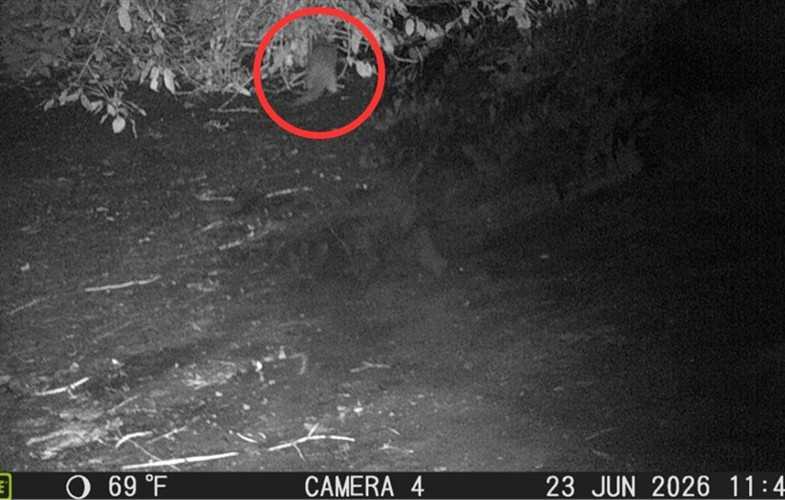
A North American river otter has been spotted in the Bronx River for the first time in nearly 100 years, according to the Wildlife Conservation Society at the Bronx Zoo.
The otter was photographed June 23 by a motion-activated camera set up by local scientist RJ Hawkins, who has been conducting long-term camera-trap monitoring along the river in collaboration with the Wildlife Conservation Society’s Education Department, based at the Bronx Zoo.
The sighting is believed to be the first documented occurrence of a river otter in the Bronx section of the Bronx River since the early 1900s.
“When I first reviewed the images, I could hardly believe what I was seeing,” Hawkins said.
“Knowing this may be the first documented river otter in the Bronx in generations was an incredible moment. It shows why long-term wildlife monitoring and environmental restoration efforts matter.”
River otters were once found throughout New York’s waterways, but their populations declined as pollution, habitat destruction and unregulated trapping took a toll on the species.
By the 1990s, river otters were primarily found in the eastern half of New York State, while western regions had largely lost the species, aside from occasional individuals passing through. Conservation efforts have since helped the species return to parts of the state.
The semi-aquatic mammals are recognizable by their dark, shiny brown fur and long, streamlined bodies. Adults typically measure between 3 and 4 feet long, including their tails, and weigh between 10 and 30 pounds.
The otter sighting comes after decades of restoration efforts aimed at reviving the Bronx River, that was once heavily polluted and neglected for decades.
Community groups, nonprofits including the Bronx River Alliance, government agencies and conservation partners have worked for decades to improve the river’s water quality, restore habitat and reconnect Bronx residents with the borough’s only freshwater river.
“This otter’s return is a gift, not just to the Bronx River but to the communities that have fought for 50 years to bring this river back to life. For too long, the Bronx River was treated as a neglected afterthought and our communities bore the burden of that neglect,” said Javier Lopez, interim executive director of the Bronx River Alliance.
“Today, this otter reminds us that when we invest in nature, nature responds, and when communities lead, change is possible,” Lopez said.
The return of wildlife has provided some of the most visible signs of the river’s recovery. Beavers returned to the Bronx River in 2007 after an absence of more than 200 years. The appearance of a river otter now offers another indication that the river and its surrounding habitat may be becoming more hospitable to native wildlife.
“There are moments in conservation that remind us why this work matters, and this is one of them,” said Craig Piper, director of the Bronx Zoo.
“Thanks to a broad coalition of public and private partners, we can celebrate the return of an otter as a result of decades of restoration work to provide cleaner water and healthier habitat. It’s a win for both wildlife and people.”
River otters can serve as an indicator of ecosystem health because they depend on clean water, healthy aquatic habitat and an adequate supply of fish and other prey.
Still, researchers caution against interpreting a single sighting as proof that river otters have permanently returned to the Bronx or established a resident population.
For now, the photograph is an encouraging sign that the Bronx River is becoming more hospitable to wildlife —a sign of hope for the river’s continued recovery.
Reach Marina Samuel at msamuel@schnepsmedia.com. For more coverage, subscribe to our newsletter and follow us on Twitter, Facebook and Instagram!